Four Things I Would Not Use For My Own Dogs

As a trainer, there are many items, equipment and services I would not use on or for my own dogs. Here are my top 4 and why I do not recommend using them.
1. Slip Leads, Tightening Headcollars or any Other Equipment that Works by Causing Pain or Discomfort

Slip leads were never meant for walking dogs. They were a way to easily slip a lead on and off a highly trained dog working in a field. If your dog pulls on a lead and you are using a slip lead, it is effectively a noose! The neck area of a dog is very delicate. Pulling using their neck can restrict blood flow and neural pathways and cause or exacerbate many physical conditions including, neck and spinal injuries. The only time I would ever use a slip lead is when transporting a flight risk rescue dog and I would only ever clip a lead directly to a collar if it were required for competing (and at this level, my dog should not be pulling anyway!). As a professional, ABTC registered trainer, I adhere to codes of conduct, which means I cannot use force or discomfort to train a dog. But speaking personally, I simply do not want to hurt my dogs. I do not want to break their trust in me or put our relationship at risk by using equipment that can cause them any pain or discomfort. Therefore, I would also never use an e-collar, prong collar, grot collar, check chain, half check, tightening headcollar or tightening harness on any of my dogs. If you need to use "non-pull" equipment to cause discomfort to your dog to stop them pulling on a walk, then they have either not been taught how to walk nicely on a lead or there is an underlying behavioural or medical issue. It is always best to speak to a qualified and accredited trainer who can help. Ultimately, if your dog is not comfortable in their equipment (and assuming they are not being forced), why would they want to walk nicely by your side? Unless I am in the ring competing, I always clip a lead to a comfy, Y-shaped harness for all my dogs.
2. Retractable Leads

I can see why so many like the convenience of an extendable lead, but when teaching your dog to walk nicely on a lead and not pull, retractable leads are a huge barrier. They teach your dog that when they feel resistance on the lead, they can pull, and they get more freedom. Then when you put a standard lead on, your dog is confused that pulling is not getting them further, so they just continuing pulling. They are also incredibly unsafe. I have seen retractable leads snap, you have very little control with them and they can cause nasty injuries if the cord get wrapped around you or your dog. I have also known dogs to bolt in fear if the lead is accidently dropped and the large plastic handle continues to chase them as they disappear out of sight! I walk my dogs on a 2M training lead. If they do not have a bombproof recall or they are a flight risk and cannot be let off a lead, I also use a 10-15M long line to give them more freedom. Yes, handling a long line does take a little -more time and skill to master, but the benefits hugely outweigh the laziness of using an extendable lead.
3. Ball Throwers/Chuckers
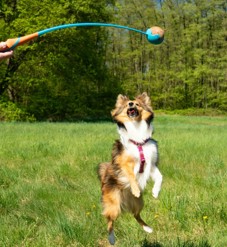
Again, they seem like a convenient way to burn some excess energy from a dog. But repetitive ball throwing is not the right type of exercise for any dog. Repetitive ball throwing is bad for a dog's body and mind. The constant running, twisting and jumping can severely increase the risk of joint disease and injury, and ball throwers mean throwing even farther and higher! It is thought that 35% of all dogs of all ages have some degree of osteoarthritis and that rises to about 80% of dogs over the age of eight. Arthritis is one of the major causes of elective euthanasia in dogs in the UK. The repetitive nature of ball throwing also causes obsessive behaviours and hyper-arousal. Rather than burning energy, it stimulates the release of more adrenaline and cortisol. We've all seen the dogs that are barking constantly for a ball to be thrown. Imagine what these dogs are feeling. Obsessive-compulsive behaviours can cause phycological distress and are mentally and physically exhausting. Often the dogs that are barking desperately for their ball to be thrown are not in a happy or playful place mentally, but they can't help it. Therefore, to protect my dogs joints, avoid hyperarousal and avoid any unwanted compulsive behaviours, I avoid ball repetitive throwing games. But I don't take away their beloved balls completely. Instead, I play, "find the ball", where I will hide the ball for them to find, I ask for a sit and a wait, whilst I throw a ball underarm a short distance, only when it has come to a complete stop will I ask them to go get it, and I also have some ball tuggy toys.
4. Doggy Daycare, Puppy Parties or Socialisation Sessions

Maybe a controversial one, but I would not send my dogs to a doggy day care centre, puppy party, group dog walk or a socialisation session at a dog field. Often I see puppies and dogs who struggle in my classes with other dogs because they have attended these types of sessions and they now find it really difficult just being around other dogs. They have little impulse control, poor manners or are just hiding under a chair! We then need to spend time retraining them in good doggy etiquette or building up their confidence again. Unfortunately, despite being well-meaning, many of the professionals running these types of events are simply not trained high enough in canine behaviour and body language to be able to manage multiple dogs in these types of set-ups. I'm currently seeing lots of videos on social media or sent to me by clients of multiple dogs in a secure dog fields having socialisation sessions, often with just 1 dog walker to 5 or more dogs. Usually the caption is that the dogs are having a great time and enjoying playing with their friends, but what I see is high-arousal, dogs who are uncomfortable in the environment, dogs being bullied by other dogs and a learning of really bad socialisation habits. If I go out, I prefer my dogs to stay at home, sleeping on the sofa. If I need to leave them for a longer period of time, I have a wonderful 5-star rated boarding kennels I use, who also do day boarding. My dogs learn good socialisation skills from attending well-run, on-lead training classes with a qualified and accredited trainer, where the aim is not to let them interact with every dog there, but to help them build impulse control and focus around other dogs.